BLOG · BILLS AND HOUSEHOLD
Bijli ka bill kaise samjhein? Units, slabs aur taxes, line by line
Short answer: start with three lines on your bill: units consumed this month, your units for the last six months, and your tariff category. Units decide your slab, and your last six months decide whether you are a protected consumer (200 units or less every month) or not. After that, the bill adds a fixed charge, the monthly fuel adjustment (FPA) and taxes such as sales tax. If one month crosses 200 units, your rate can stay higher for the next six months, which is why one hot month can make several bills bigger.
Bill par sab se pehle kya dekhein?
Every DISCO and K-Electric bill looks a little different, but the same pieces are on all of them. Check them in this order:
- Units consumed: the current meter reading minus the previous reading. This is the number everything else depends on.
- Reading dates: a reading taken late covers more days, so it shows more units.
- Units history: most bills print your units for the past months. Look at the last six.
- Tariff or category: for a home this is the residential (A-1) tariff, and the bill shows whether you are protected.
- Cost of electricity: units multiplied by your slab rate.
- Fixed charges, FPA and taxes: added on top (explained below).
- Due date and late payment amount: the bill shows a higher amount if you pay after the due date.
If the reading looks wrong, read your own meter on the next reading day and compare. Take a photo of the meter with the date on it, so you have proof if you need to complain to your DISCO.

Slabs kya hain, aur rate kitna hai?
NEPRA, the power regulator, set one uniform residential tariff for calendar year 2026 in its decision of February 11, 2026. These are the per-unit rates in that decision, before fixed charges, FPA and taxes:
| Monthly units | Protected (Rs per unit) | Not protected (Rs per unit) |
|---|---|---|
| 1 to 100 | 10.54 | 22.44 |
| 101 to 200 | 13.01 | 28.91 |
| 201 to 300 | — | 33.10 |
| 301 to 400 | — | 36.46 |
| 401 to 500 | — | 38.95 |
| 501 to 600 | — | 40.22 |
| 601 to 700 | — | 41.85 |
| Above 700 | — | 47.20 |
Lifeline consumers, a separate category for very small users, have their own lower rates of Rs 3.95 (up to 50 units) and Rs 7.74 (51 to 100 units). Rates can change through a new NEPRA decision, so always compare with the rate printed on your own bill.
Protected aur non-protected ka farq kya hai?
You are protected if you used 200 units or less in each of the last six months. As Dawn reported in February 2026, crossing the limit even once means you lose that status until you have six months within it again.
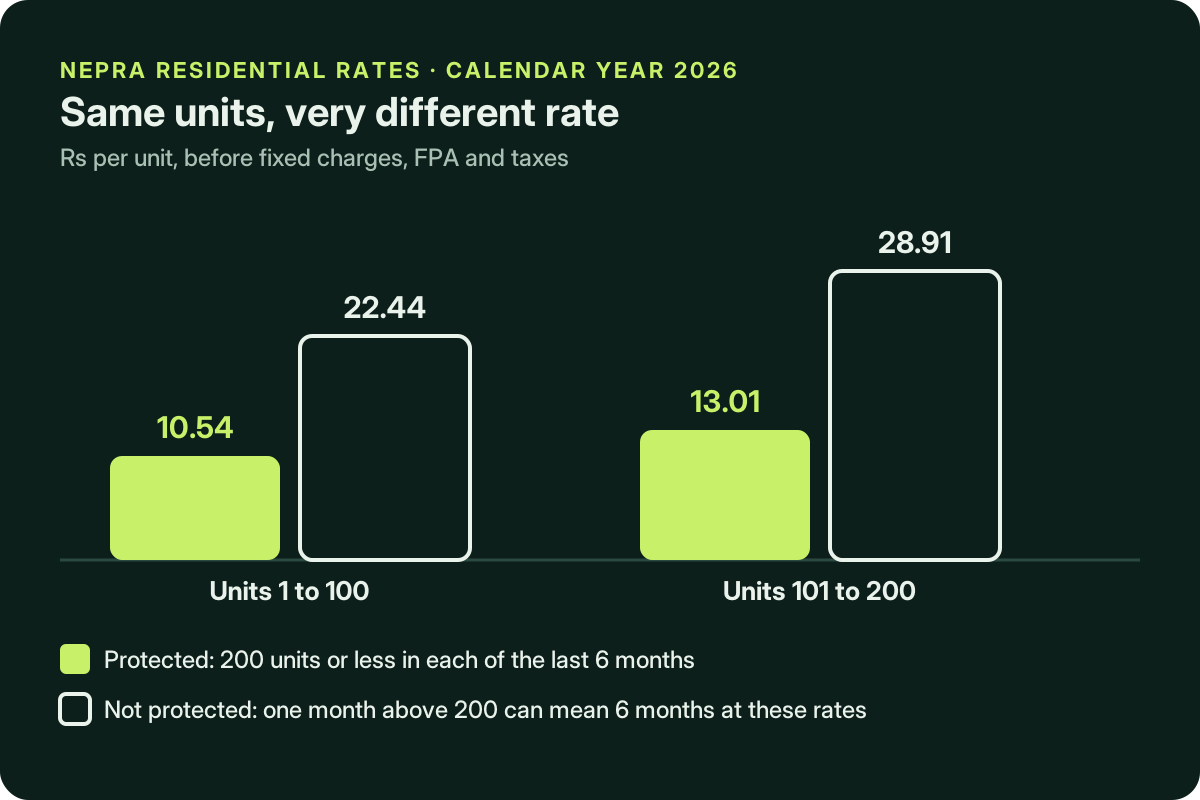
The difference is large. For the first 100 units, the protected rate is Rs 10.54 and the non-protected rate is Rs 22.44, more than double. So a summer month at 220 units does not only cost you for those 20 extra units: it can make the next six bills bigger too.
Is this rule changing? On October 28, 2026, the energy minister told the Senate that the government plans to end this six-month penalty. As of November 3, 2026 we found no official notification, so the rule above still applies until NEPRA or the Power Division announces a change.
Fixed charges kyun lag rahe hain?
Since NEPRA's February 2026 decision, most homes pay a fixed charge every month, even if they use very little. Before this, only bigger users paid one. NEPRA's decision sets it per kW per month, from Rs 200 (protected, up to 100 units) to Rs 675 (non-protected, above 500 units). Lifeline consumers do not pay it. Look for the "fixed charges" line on your bill.
FPA aur taxes kya hote hain?
| Line on the bill | What it is |
|---|---|
| FPA (fuel price adjustment) | The difference between the fuel cost assumed in the tariff and the real cost in an earlier month. NEPRA decides it; it can be added or taken off. |
| Sales tax (GST) | 18% on the electricity bill, as reported in Business Recorder in June 2026. |
| Income tax | Can be added to larger bills under section 235 of the income tax law, with a higher rate for people not on FBR's Active Taxpayers List. Check FBR's current rate card. |
| Electricity duty | No longer collected through electricity bills since July 1, 2025. |
| PTV fee | The Rs 35 monthly TV fee was taken off electricity bills in 2025. |
If you still see electricity duty or the TV fee on a recent bill, ask your DISCO why.
Bijli ke bill ka hisaab kaise rakhein?
A bill is easier to control when you can see it next to last month's:
- Write down units, not only the amount. Units show whether you used more; the amount also moves with FPA and taxes.
- Watch the 200-unit line in summer. If your units history is close to 200, a few cooler days or one less appliance running can keep you protected.
- Note the due date. Paying late adds a surcharge you can avoid.
- Record what you paid as part of your monthly kharcha, so the month shows where the money went.
Z30 does not read your bill, track units or remind you of due dates. You can record the payment in one line, for example bijli bill 8450 HBL se, and see it in your month by category.
FAQ
Why is my bill high when I used fewer units this month?
Check your units history. If one of the last six months was above 200 units, you may still be non-protected. Also check the FPA line and the reading dates.
Does the 200-unit rule count units per month or in total?
Per month. Each of the last six monthly readings must be 200 units or less to stay protected.
Are these rates the same in Karachi?
NEPRA's February 2026 decision set one uniform tariff for both the government-owned DISCOs and K-Electric. Your bill shows the rate that applies to you.
What if my reading is wrong?
Take a dated photo of your meter and complain to your DISCO's customer service before the due date. Keep the complaint number.
Sources
- NEPRA decision on rationalization of tariff for XWDISCOs and K-Electric, NEPRA, February 11, 2026 (residential rates, lifeline rates, fixed charges)
- NEPRA imposes fixed charges on domestic consumers using up to 300 units per month, The Express Tribune, February 11, 2026
- 'Relief' for industry as government shifts burden to domestic bills, Dawn, February 7, 2026 (six-month protected rule)
- Good news for electricity consumers using 200 units per month, Daily Pakistan, October 28, 2026 (minister's plan to end the six-month penalty)
- NA body informed: Rs620bn taxes collected through power bills, Business Recorder, June 18, 2026 (18% sales tax)
- FBR electricity withholding tax rates for TY2027, PkRevenue, August 14, 2026 (section 235)
- Govt to end collection of electricity duty via bills, The Express Tribune (from July 1, 2025)
- Government approves Rs11 billion subsidy for PTV after TV fee withdrawal, Profit, August 27, 2025
- Power Division FAQ on electricity bill charges, Ministry of Energy (Power Division) (what FPA is)
Try it with your own money: one line at a time.
Start freeRead next
- Committee ka hisaab kaise rakhein? A simple record for your monthly committee
Committees (ROSCAs) are how many Pakistanis save, but they run on trust and memory. What to write down, the risks to watch, and a simple record that keeps every payment clear.