BLOG · SALARY AND BUDGETING
Does the 50/30/20 budget rule work on a Pakistani salary?
Short answer: the 50/30/20 rule splits your take-home pay into 50% for needs, 30% for wants and 20% for savings. It is a useful starting shape, but for many households in Pakistan the needs part is bigger than 50%. Pakistan's latest official household survey found that food and housing (rent, electricity, gas, water) take about 62% of what an average household spends. So treat 50/30/20 as a direction, not a test you fail: measure your own month first, then set a split you can actually keep.
What is the 50/30/20 rule?
The rule comes from All Your Worth, a 2005 book by Elizabeth Warren and Amelia Warren Tyagi. The idea is simple: after tax, divide your income into three buckets.
| Bucket | Share | What goes in it |
|---|---|---|
| Needs | 50% | Things you must pay: rent, bijli and gas bills, groceries, school fees, transport to work, minimum loan payments |
| Wants | 30% | Things you choose: eating out, new clothes beyond the basics, subscriptions, outings |
| Savings | 20% | Money kept for the future, and paying down debt faster |
The appeal is that you do not have to plan every rupee. You only watch three numbers.
Two details matter. First, it uses take-home pay: the amount that reaches your account after income tax and other salary deductions, not your gross salary on the offer letter. Second, the buckets are about why you spend, not where. Basic groceries are a need; a restaurant dinner is a want, even though both are food.
What do Pakistani households actually spend on?
The Pakistan Bureau of Statistics (PBS) released the Household Integrated Economic Survey (HIES) 2024-25 on January 1, 2026. It is the official picture of how households earn and spend. These are its shares of monthly household spending:

| Spending group (HIES 2024-25) | Share of spending |
|---|---|
| Food and non-alcoholic drinks | 36.7% |
| Housing, water, electricity, gas and other fuels | 25.7% |
| Restaurants and hotels | 6.6% |
| Clothing and footwear | 6.3% |
| Transport | 6.2% |
| Health | 3.3% |
| Education | 2.5% |
The same survey puts average monthly household income at Rs 82,179 and average monthly consumption spending at Rs 79,150. That means the average household spends about 96% of what comes in. Food and housing together are about 62% of spending, and everything else is the remaining 37.6%.
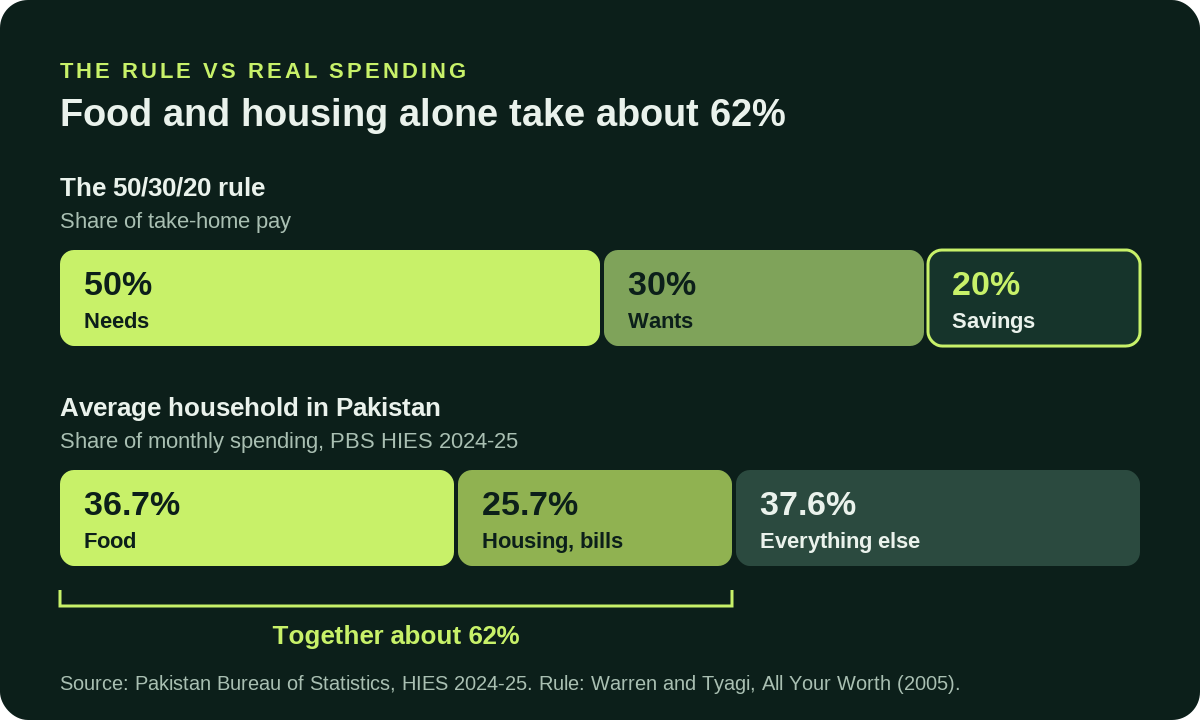
Be careful with these averages. They cover whole households, not one salary, and not all of food or housing is a "need" in the 50/30/20 sense. But the direction is clear: food plus housing alone come to around 60% of average income, before transport, school fees or medicine. For a typical family, a 50% needs limit is hard to meet in the first month.
So should you drop the rule?
No. The rule is still useful for one reason: it makes you separate needs from wants, and it puts saving on the list before the month ends, not after. What you change is the numbers.
Some people use a different split while their needs are high, for example 60/30/10 or 70/20/10. These are examples, not recommendations. The right split is the one your own numbers support, and it can change as your salary or rent changes.
A simple way to find yours:
- Track one full month without changing anything. Write down every expense, including cash, JazzCash or Easypaisa payments and small daily kharcha.
- Label each expense as a need or a want. Be honest. A phone package for work is a need; the third food delivery of the week is a want.
- Add up the three buckets and divide each by your take-home pay. That is your real split today.
- Pick a target one step better, for example moving 5% from wants to savings. Big jumps usually do not last.
- Move savings first. On salary day, put the savings amount aside before you start spending.
- Check again next month and adjust.
A filled-in example
Example only: Sara's take-home pay is Rs 100,000.
| Bucket | 50/30/20 target | Sara's real month (example) |
|---|---|---|
| Needs | Rs 50,000 | Rs 64,000 |
| Wants | Rs 30,000 | Rs 26,000 |
| Savings | Rs 20,000 | Rs 10,000 |
Sara's real split is 64/26/10. The rule says her needs are too high, but rent and bills do not shrink in a month. A realistic next step is to keep needs where they are, trim wants by Rs 5,000 and save Rs 15,000. That is 64/21/15: not the textbook split, but better than last month.
Where do udhaar, committees and family support go?
These do not fit the rule neatly, so decide once and stay consistent:
- Committee payments: many people count them as savings, because the money comes back to them as a lump sum. Keep a record of every payment.
- Paying back a loan you took: the book puts faster debt repayment with savings. The minimum you must pay is a need.
- Money you lend to a friend (udhaar diya): it is not spending and not really savings either, because you may wait a long time for it. Track it separately so you know who owes you.
- Sending money to parents or family: for many salary earners this is a fixed duty, so it often sits with needs. It is your call.
How Z30 can help with the tracking part
The hard part of any budget rule is step 1: knowing what you actually spent. Z30 lets you record each expense in one line, in English or Roman Urdu (for example petrol 450 cash), and keeps money you lent and borrowed separate from spending. You can ask "is mahine kitna kharch hua?" and see your month by category.
Z30 does not have a 50/30/20 view and does not label expenses as needs or wants for you. You still decide which categories are needs. Every new account gets 3 months free; paid plans start after that.
FAQ
Is 50/30/20 calculated on gross salary or take-home pay?
On take-home pay, after income tax and other deductions. Using gross salary makes every bucket look bigger than the money you really have.
My needs are more than 70% of my salary. What then?
Start by tracking and saving a small fixed amount, even if it is far below 20%. If needs stay that high, the fix is usually on the needs side (rent, transport, bills) rather than cutting wants to zero.
Is a committee better than saving in a bank?
That depends on your situation and the people in the committee; this post does not give investment advice. Whatever you choose, keep a written record of every payment.
Is the 50/30/20 rule halal?
We do not rule on religious questions. If you are unsure about where your savings are kept, such as profit or interest on a bank account, ask a scholar you trust; they will want to know the type of account and how it earns.
Sources
- Simon & Schuster, All Your Worth by Elizabeth Warren and Amelia Warren Tyagi, published March 8, 2005 (book details, checked November 6, 2026).
- Morningstar, How to use the 50/30/20 rule for budgeting, May 31, 2019 (definition: after-tax income, needs, wants, savings and debt repayment).
- Pakistan Bureau of Statistics, HIES 2024-25 final results presentation (spending shares, average monthly income Rs 82,179 and consumption Rs 79,150).
- Pakistan Bureau of Statistics, HIES 2024-25 press release (launched January 1, 2026; food 37%, housing and fuel 26%).
- The Express Tribune, Food, housing consume 63% of household spending in Pakistan, January 2, 2026 (context).
Try it with your own money: one line at a time.
Start freeRead next
- GUIDESalary kahan jaati hai? How to see where your monthly salary goes
Salary comes on the 1st and is gone by the 20th. A simple way for salary earners in Pakistan to see where it goes: write each spend in one line and let the month add itself up.
- What to do on salary day: a 30-minute plan for your first week
A simple 30-minute routine for salary earners in Pakistan: check the credit, pay fixed bills, set money aside, settle udhaar and plan the month.
- How to read your salary slip: basic pay, allowances and deductions
For salary earners in Pakistan: what each line on a salary slip means, how income tax on salary is worked out for tax year 2027, and what EOBI and provident fund deductions are.
- How to keep track of money you send to family every month
For salary earners in Pakistan who support parents or siblings: how to separate regular support, one-off help and udhaar, and set a limit you can keep.