BLOG · UDHAAR AND PEOPLE
How to keep track of money you send to family every month

Short answer: put money you send to family into three groups: regular support, one-off help, and udhaar you expect back. Give regular support a fixed monthly limit that you decide on salary day, before the month starts. Write every transfer down on the day you send it, with who it went to and what it was for. This keeps your family relationships warm and your own month clear.
Why does family money feel so hard to track?
Because it rarely arrives as a bill. A parent mentions a repair, a sibling needs fees, an aunt is ill. You send what you can, quickly, and move on. Nobody sends you a statement.
By the end of the month the total can surprise you. Not because you were careless, but because each transfer felt small and urgent. There is also a quiet pressure: it can feel unkind to count money you give to people you love.
Counting is not unkind. A clear number is what lets you keep helping month after month, instead of running dry and having to cut off support suddenly.
What are the three kinds of family money?
Most transfers fit one of these groups. Naming the group is the main step.
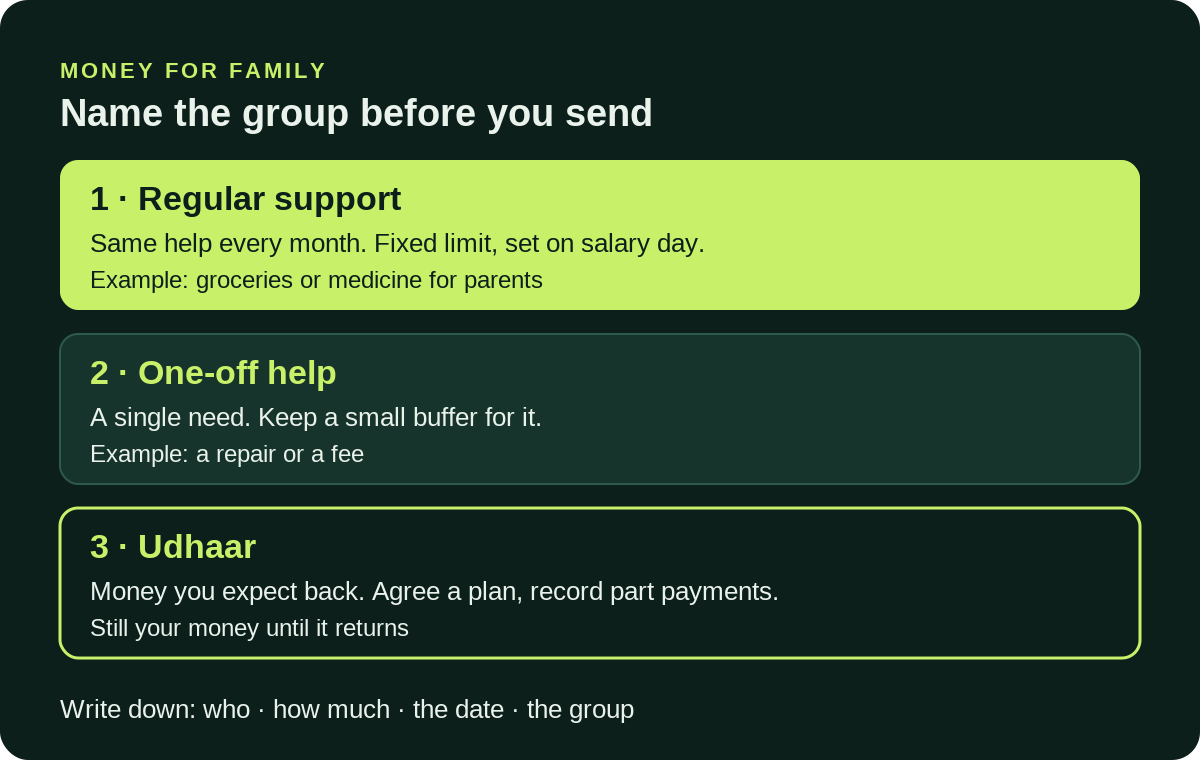
| Group | What it is | How to handle it |
|---|---|---|
| Regular support | The same kind of help every month, such as groceries, a parent's medicine or a sibling's fee | Set a fixed monthly amount on salary day and treat it like a bill |
| One-off help | A single need: a repair, a hospital visit, a wedding gift | Agree on it, send it, and note it. Check it against your emergency savings if it is large |
| Udhaar | Money you expect back | Note who, how much and the date, and record every part payment. See what to ask before you lend |
The groups matter because they behave differently. Regular support is a planned cost. One-off help is an event. Udhaar is not spending at all: it is money that is still yours until it comes back.
How do you set a monthly limit for family support?
Do this once a month, ideally in your salary day plan.
- Add up what you sent last month. Use your wallet and bank history, plus cash you remember. An honest total is better than a perfect one.
- Split it into the three groups. Which part was regular, which was one-off, which was meant to come back?
- Pick a regular amount you can keep. Choose a number you could send even in a tight month, not your best month.
- Keep a small buffer for one-off help. A few emergencies will come. A fixed buffer means you do not have to borrow when one does.
- Tell your family the arrangement. "I will send this on the 1st of every month" is easier to live with than a surprise every week.
If your family expects more than the limit allows, say so early and kindly. You can suggest other ways to help, such as paying a bill directly or helping with a task, instead of sending extra cash.
What should you write down for each transfer?
Keep it short. Four details are enough:
- Who received it
- How much
- The date
- The group: regular, one-off or udhaar
If it is udhaar, add the plan you agreed ("returned in two parts after the next two salaries"). If it is a gift, you do not need to track a return. Write it as a gift once and let it go.
How does Z30 help with this?
You write each transfer as one line, in English or Roman Urdu. For money you expect back, a line like Ali ko 5000 diye is how you would record a loan, and when Ali returns part of it you write Ali ne 2000 wapas kiye. Z30 links the repayment to the loan and shows what is still owed. If a line is unclear, such as Amjad 4800, Z30 asks whether you lent, borrowed or paid, instead of guessing.
Z30 does not decide for you which group a transfer belongs to, and it does not send money, remind your family or connect to your bank. It keeps your own record, and your month view shows where your salary went. Every new account gets 3 months free, with no payment details needed.
FAQ
Should I count money for my parents as an expense?
Yes, if you do not expect it back. It is a real cost to your month, so plan for it the way you plan for rent. Tracking it does not mean you love them less; it means you can keep helping.
What if my family asks for more than my limit?
Decide your answer before the conversation, not during it. You can offer a smaller amount, a different kind of help, or a date when you can revisit the limit.
Should I note small amounts as well?
Yes, if they repeat. A few small transfers in a month can add up to a large amount. One quick line each time is enough.
Is money for my family udhaar?
Only if you both agree it will come back. If you are not expecting it back, treat it as support or a gift. If you are not sure, ask kindly and note the answer, so there is no confusion later.
Sources
- Zero Before 30, homepage (what Z30 records today: money lent and borrowed, partial repayments, one clarifying question when a line is unclear, no bank connection; checked November 23, 2026).
- Zero Before 30, pricing (3 months free, no payment details needed to start; updated November 14, 2026).
- This post uses no external figures. The groups and the monthly-limit steps are general budgeting practice, not a ruling or a financial product recommendation.
Try it with your own money: one line at a time.
Start freeRead next
- GUIDEUdhaar kaise yaad rakhein? How to keep track of money lent to friends
A simple way to remember who owes you and whom you owe in Pakistan: write one line per udhaar, record partial repayments, and see the balance per person.
- Should you lend money to a friend? 5 questions to ask first
For salary earners in Pakistan asked for udhaar by a friend: five questions that help you decide how much to lend, if at all, and how to keep the record clear.
- Rent and advance: how to keep a clear record of what you paid and what you get back
Paying rent and an advance (security deposit) on a salary? What to write down so you can prove every payment and get your advance back without an argument.
- How to plan school fees across the whole year on a salary
For salary earners with children in school: turn the big yearly costs into a small monthly amount, so the fee month does not break your budget.