BLOG · SALARY AND BUDGETING
How to read your salary slip: basic pay, allowances and deductions

Short answer: a salary slip has two halves. The top half is what you earned: basic pay plus allowances, which together make your gross salary. The bottom half is what was taken out before the money reached you: usually income tax, often an EOBI contribution, and a provident fund contribution if your company has one. Gross salary minus deductions is your net (take-home) pay, and that is the number to plan your month with.
What are the parts of a salary slip?
Every company's layout is different, but most slips in Pakistan have these parts:
| Line on the slip | What it means |
|---|---|
| Basic pay | The fixed core of your salary. Provident fund and some other amounts are often calculated as a share of basic, not of gross. |
| Allowances | Extra amounts on top of basic, such as house rent, medical, conveyance or utilities. Names and amounts depend on your employer. |
| Gross salary | Basic pay plus all allowances for the month. |
| Income tax | Tax your employer deducts from your salary each month and pays to FBR on your behalf. |
| EOBI | Your share of the old-age pension contribution, if your employer is registered with EOBI. |
| Provident fund | A part of your pay saved in the company's fund, if it has one. |
| Other deductions | Loan or advance repayments, unpaid leave, or anything else agreed with your employer. |
| Net pay | Gross salary minus all deductions. This is what lands in your account. |
Some slips also show a "taxable income" or "taxable salary" line. If yours does, that is the figure your employer used for income tax. It can be different from gross, because tax law can treat some allowances differently. If the slip does not explain the difference, ask your HR or payroll team.

How is income tax on salary worked out?
Your employer deducts income tax from your salary under section 149 of the Income Tax Ordinance, 2001. In practice, payroll estimates your taxable salary for the whole year, works out the yearly tax from the official slabs, and spreads it over the months. If your salary changes mid-year, the monthly deduction usually changes too.
These are the salary tax slabs in FBR's withholding tax rate card, updated up to June 30, 2026 as per the Finance Act, 2026 (as of November 2026):
| Taxable salary per year | Tax per year |
|---|---|
| Up to Rs 600,000 | Nil |
| Rs 600,001 to Rs 1,200,000 | 1% of the amount above Rs 600,000 |
| Rs 1,200,001 to Rs 2,200,000 | Rs 6,000 + 11% of the amount above Rs 1,200,000 |
| Rs 2,200,001 to Rs 3,200,000 | Rs 116,000 + 20% of the amount above Rs 2,200,000 |
| Rs 3,200,001 to Rs 4,100,000 | Rs 316,000 + 25% of the amount above Rs 3,200,000 |
| Rs 4,100,001 to Rs 5,600,000 | Rs 541,000 + 29% of the amount above Rs 4,100,000 |
| Rs 5,600,001 to Rs 7,000,000 | Rs 976,000 + 32% of the amount above Rs 5,600,000 |
| Above Rs 7,000,000 | Rs 1,424,000 + 35% of the amount above Rs 7,000,000 |
Two things changed with the Finance Act, 2026. FBR's Circular No. 2 of 2026-27 (September 8, 2026) says the rates in several salary slabs were reduced, and that the 9% surcharge has been withdrawn for salaried individuals.
The rates apply to your yearly taxable salary, not your monthly one. A Rs 50,000 monthly salary is Rs 600,000 a year, which falls in the nil slab. FBR's own card says the law itself (the Ordinance) prevails if anything on the card is wrong, so for your own case, check with FBR or a tax adviser.
A filled-in example
Example only. Ali's slip shows a gross salary of Rs 150,000 a month, and for this example we assume all of it is taxable.
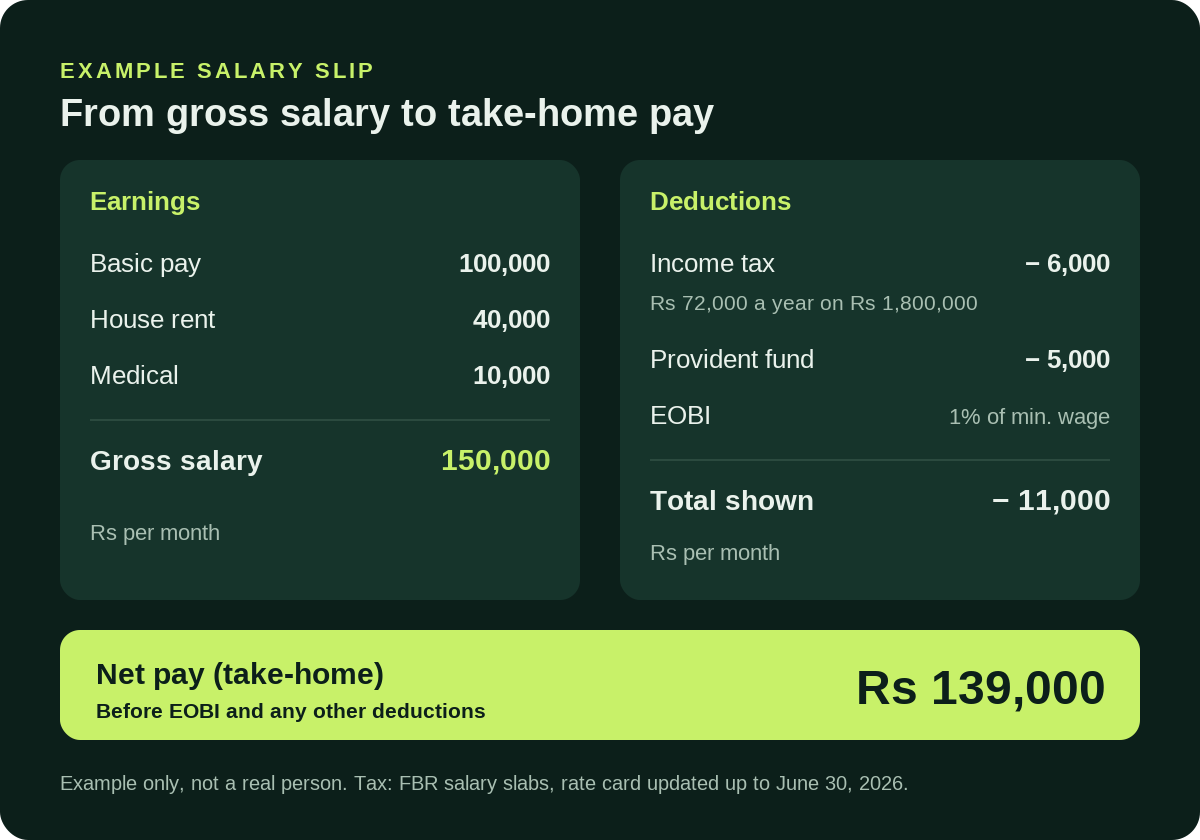
Here is how the income tax line comes out, step by step:
- Yearly salary: Rs 150,000 × 12 = Rs 1,800,000.
- Find the slab: Rs 1,800,000 is in the Rs 1,200,001 to Rs 2,200,000 slab.
- Amount above the slab start: Rs 1,800,000 − Rs 1,200,000 = Rs 600,000.
- Yearly tax: Rs 6,000 + 11% of Rs 600,000 (Rs 66,000) = Rs 72,000.
- Monthly deduction: Rs 72,000 ÷ 12 = Rs 6,000.
The provident fund figure of Rs 5,000 is also only an example. The real amount depends on your company's fund rules. Your real slip may also have an EOBI line and other deductions that this example leaves out.
What are EOBI and provident fund deductions?
EOBI is the Employees' Old-Age Benefits Institution, which runs a pension scheme for private-sector workers. Under the scheme, the employer pays 5% and the employee pays 1% of the minimum wage each month, according to Business Recorder (August 22, 2026). Because it is based on the minimum wage and not on your salary, your EOBI line is small and the same for everyone at your company, and it goes up when the minimum wage is raised. If you see no EOBI line, ask HR whether you are registered.
Provident fund is a savings fund some employers run. A part of your pay goes into it each month, and the fund rules say how much the company adds, when you can withdraw, and what happens when you leave. Ask HR for the fund rules in writing. It is your money, so keep a record of what has gone in.
What should you check every month?
- Gross matches your offer letter or your latest increment letter.
- Income tax looks right for your yearly salary, using the table above.
- No surprise deductions. Every line under deductions should be something you know about.
- Net pay matches what reached your bank account.
- Keep every slip. They help when you apply for a loan, change jobs, or check your tax record.
Where Z30 fits
Z30 does not read salary slips and does not calculate your tax. What it does today is record your money in one line. When your salary arrives, you can type salary aayi 139000 HBL, then record what you spend from it the same way (bijli bill 8450 HBL se), and ask "is mahine kitna kharch hua?" to see your month by category. Every new account gets 3 months free; paid plans start after that.
FAQ
Why did my tax deduction change this month?
Usually because your yearly salary estimate changed: an increment, a bonus, or a correction for earlier months. Ask payroll to show you the yearly figure they used.
Is tax worked out on basic pay or gross salary?
On your taxable salary, which usually includes allowances. If your slip shows a separate taxable income line, that is the figure used. Check with HR or a tax adviser for your own case.
My employer deducts tax. Do I still need to file a return?
FBR's rules decide who must file, and many salaried people do file. This post does not give tax-filing advice; check FBR's website or ask a tax adviser.
Is the provident fund profit halal?
We do not rule on religious questions. Ask a scholar you trust; they will want to know how your company's fund is invested and how it earns.
Sources
- Federal Board of Revenue, Withholding Income Tax Rate Card, updated up to June 30, 2026 as per Finance Act, 2026 (section 149 salary slabs; checked November 11, 2026).
- Federal Board of Revenue, Circular No. 02 of 2026-27, September 8, 2026 (salary rates reduced; 9% surcharge withdrawn for salaried individuals).
- Federal Board of Revenue, Income Tax Ordinance, 2001, amended up to June 30, 2026 (the law the rate card follows).
- Business Recorder, EOBI projected deficit, August 22, 2026 (EOBI contributions: employer 5%, employee 1% of the minimum wage).
- The Express Tribune, Budget 2026-27: Govt cuts taxes, ends surcharge for four salaried class income slabs, June 12, 2026 (context).
Try it with your own money: one line at a time.
Start freeRead next
- GUIDESalary kahan jaati hai? How to see where your monthly salary goes
Salary comes on the 1st and is gone by the 20th. A simple way for salary earners in Pakistan to see where it goes: write each spend in one line and let the month add itself up.
- What to do on salary day: a 30-minute plan for your first week
A simple 30-minute routine for salary earners in Pakistan: check the credit, pay fixed bills, set money aside, settle udhaar and plan the month.
- Does the 50/30/20 budget rule work on a Pakistani salary?
For salary earners in Pakistan: what the 50/30/20 rule says, what official survey data shows about real household spending, and how to adjust the split.
- How to keep track of money you send to family every month
For salary earners in Pakistan who support parents or siblings: how to separate regular support, one-off help and udhaar, and set a limit you can keep.