BLOG · BILLS AND HOUSEHOLD
Rent and advance: how to keep a clear record of what you paid and what you get back
Short answer: treat your monthly rent as a normal expense, and treat your advance as money you have lent to your landlord that should come back. Keep one record with the agreed rent, the advance amount, the date and method of every payment, and a written note of what was agreed about returning the advance. Most rent arguments are really memory arguments, and a dated record settles them.
This post is about record-keeping only. Rent and deposit rules differ by province and city, so it does not explain the law. For legal questions, read your own agreement and the official text for your area, or ask a lawyer.
What is the difference between rent and an advance?
Rent is the amount you pay every month to live in the house. It is gone: it is an expense, like a bill.
The advance (also called a security deposit) is a one-time amount you give the landlord at the start. It is not a cost of living there. It is meant to come back when you leave, usually after the landlord checks the house. So in your own books it is closer to money you lent than to money you spent.
If you mix the two, your first month looks very expensive and your later months look cheaper than they are. Worse, you forget that a large amount of your money is sitting with someone else.
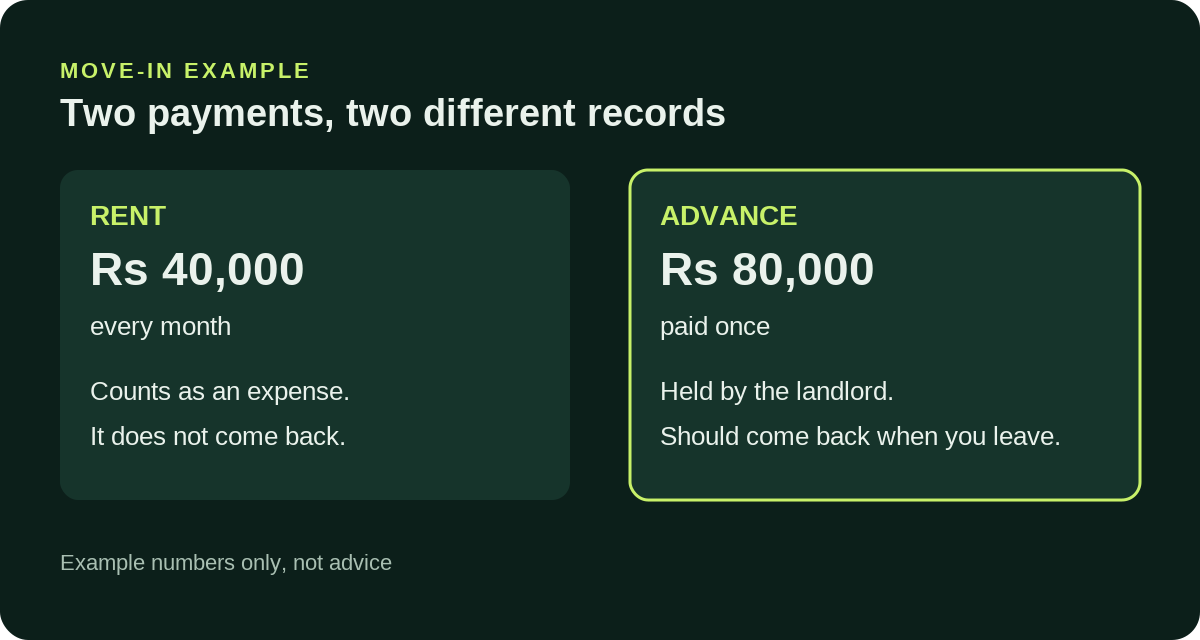
The amounts above are an example, not a recommendation. Use your own numbers.
What should you write down on day one?
Before you hand over any money, write these down, and ask the landlord to confirm them in a message or in the agreement:
| What | Example | Why it matters |
|---|---|---|
| Monthly rent | Rs 40,000 | The number your budget depends on |
| Advance amount | Rs 80,000 | What should come back to you |
| Date rent is due | By the 5th | Avoids "you were late" arguments |
| What the rent includes | Water yes, gas no | Stops surprise bills |
| How the advance is returned | Within a set number of days after you leave | The most common source of disputes |
| Possible deductions | Repairs beyond normal use | Agree the rules before you move in |
| Condition of the house | Photos with the date | Proof of how it looked when you arrived |
| Notice period | One month, in writing | Avoids a month of rent you did not plan for |
If the landlord does not want to put these in writing, that is useful information too. A friendly message that says "Just confirming: rent Rs 40,000, advance Rs 80,000, returned when we leave" is a small step that already helps.
How do you record each rent payment?
Every month, keep four details:
- The amount.
- The date you paid.
- How you paid (cash, bank transfer, wallet).
- Proof: a transaction screenshot, or a message from the landlord saying "received".
For cash, ask for a short written receipt or a message the same day. Do not rely on "he knows I paid". If you pay by bank transfer or wallet, the transaction ID is your proof, so do not delete the message.
How do you track the advance while you live there?
Your advance is the one amount people forget. Do these three things:
- Write it in your records once, with the date you paid and how.
- Look at it every few months, so you know how much of your savings is held by the landlord.
- Keep the agreement, the photos and the payment proof in one folder on your phone.
When you plan to leave, count the notice period backwards. Tell the landlord in writing, take dated photos of the house on your last day, and write down the date the advance is due back.
How do you plan your salary around rent?
Rent is usually the biggest fixed amount in the month, so put it first. On salary day, set the rent aside before you plan anything else. If your rent is paid on the 5th and your salary arrives on the 28th, that gap is your risk: save your rent as a separate amount, not mixed with the rest. Our salary day plan shows a simple order for the first week.
Moving costs more than the rent. The first month needs the new advance, the first rent, transport and small setup costs, usually before you get the old advance back. If you expect the old advance to arrive late, plan the move so you do not depend on it.
What can Z30 do for rent and advance?
Z30 has no rent feature, no reminders and no deposit feature today. It does not know about your agreement.
What you can do is write each rent payment as one line, the way you would say it, for example kiraya 40000 HBL se. That records an expense and keeps your month honest. For the advance, Z30 tracks money you lent and who owes you, so you can record it as money given to the landlord that he owes back. Whether to count it that way is your choice, since Z30 only records what you write. Keep the agreement and receipts outside Z30.
FAQ
Should I count my advance as an expense?
No. The advance is meant to come back, so it is closer to money you lent than money you spent. Count only the part you actually lose, if any deductions are agreed, as a cost.
What if my landlord says there is no need to write anything down?
You can still keep your own record: dates, amounts, how you paid and the proof. Then send a short message to confirm the rent and advance. A message from you, with a date, is better than nothing.
How do I avoid an argument when I leave?
Agree the return rules before you move in, take dated photos of the house on the first and last day, give notice in writing, and keep every payment proof. If there is a real dispute about the law, ask a lawyer or read the official rent law for your province.
Sources
- Zero Before 30: what Z30 does today (updated 14 November 2026)
- Zero Before 30: pricing (updated 14 November 2026)
Try it with your own money: one line at a time.
Start freeRead next
- GUIDESalary kahan jaati hai? How to see where your monthly salary goes
Salary comes on the 1st and is gone by the 20th. A simple way for salary earners in Pakistan to see where it goes: write each spend in one line and let the month add itself up.
- How do you cut your mobile and internet spending without losing signal?
For salary earners in Pakistan: find your real monthly mobile and internet cost, see what the FBR rate card says about tax on top-ups, and trim the waste, as of November 2026.
- Why is your gas bill higher in winter? Slabs, protected status and fixed charges
For households on Sui gas in Pakistan: why winter bills jump, how the hm3 slabs and the protected category work, and the fixed charges, as of November 2026.
- How to read your electricity bill: units, slabs and taxes, line by line
For households in Pakistan: how to read units, slabs, the 200-unit protected rule, fixed charges, FPA and taxes on your electricity bill, as of November 2026.