BLOG · LIFE EVENTS
How to plan school fees across the whole year on a salary
Short answer: list every school cost for the year, not just the monthly tuition. Add the lump sums (admission or annual charges, books, uniform, exam fees), divide by 12, and move that amount into a separate place each salary day. Then the start of the session is paid from money you already set aside, not from your rent or bills money. Rules on fee increases differ by province, so ask the school and read its fee schedule before you plan.
Why do school fees break the monthly budget?
Tuition is regular, so it fits in a budget. The trouble is the other costs. They arrive in one or two months, often together, and they are easy to forget when you plan.
If you only budget for tuition, the lump sums land on top of a normal month. That is when people borrow, break a committee early or delay a bill. The fix is not to earn more overnight. It is to see the whole year first.
What costs should you list?
Ask the school for its current fee schedule in writing, or check your last few fee challans. Then list:
| Cost | How often it comes | Often forgotten? |
|---|---|---|
| Tuition | Every month | No |
| Admission or annual charges | Once a year, or once at joining | Yes |
| Books and stationery | Start of session | Yes |
| Uniform and shoes | Start of session, sometimes mid-year | Yes |
| Exam or paper fees | Once or twice a year | Yes |
| Van or transport | Every month | Sometimes |
| Trips, events, projects | A few times a year | Yes |
Do this once a year, when the new session starts. Keep the list, so next year you can compare.
How do you turn the lump sums into a monthly amount?
Add the yearly lump sums, divide by 12, and set that amount aside every month. Here is an example with made-up numbers:
- Admission or annual charges: Rs 12,000.
- Books and stationery: Rs 12,000.
- Uniform and shoes: Rs 6,000.
- Exam and activity fees: Rs 6,000.
- Total Rs 36,000, divided by 12 is Rs 3,000 a month.
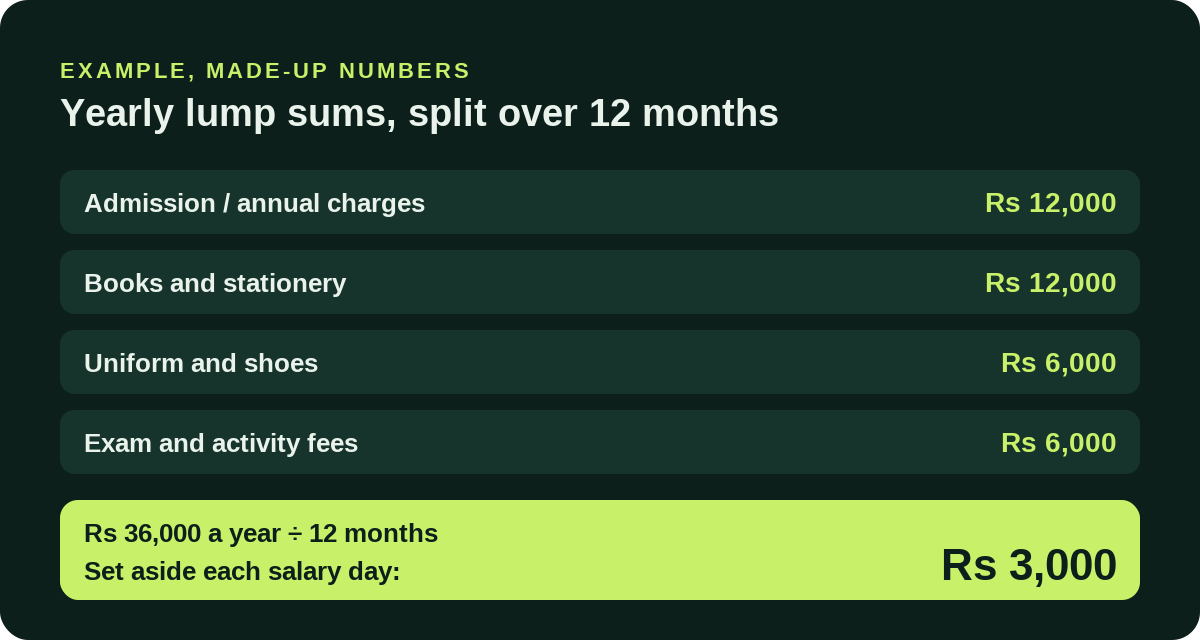
These amounts are an example, not an average. Use your own school's numbers. If Rs 3,000 is too much, set aside what you can and start earlier next year. A smaller amount still shrinks the gap.
Keep this money apart from your spending account, for example in a separate wallet or bank account that you do not use daily. This is a planned cost, so it should not come out of your emergency fund. Our guide on how big an emergency fund should be explains why the two stay separate.
What should you check about fee increases?
Fees can rise at the next session, so plan for that too. The rules depend on where the school is, and they change, so treat this as a reason to ask, not as legal advice.
- In Sindh, Dawn reported in July 2026 that schools may normally raise fees by five percent only after the provincial directorate approves it, and that unapproved increases can be reversed with a refund.
- In Islamabad, the regulator PEIRA notified a policy in August 2021 that schools must disclose their fee schedule and all other charges before admission, and may not raise fees during a session.
If a charge looks new or unclear, ask the school for the reason in writing. If you are not satisfied, contact the regulator for your province or area.
How can you track it in Z30?
Z30 is a money tracker where you type one line. For example: school fees 8000 cash or books 3500 JazzCash. Z30 records each as an expense with the date and how you paid.
At the end of the month, you can ask "is mahine kitna kharch hua?" and see your month by category. Z30 does not move money for you, does not connect to your bank, and does not send school-fee reminders. Setting aside the monthly amount is something you do yourself; Z30 helps you see what you actually spent.
FAQ
When should I start saving for the next session?
As early as you can, ideally the month after this session's lump sums are paid. Twelve small amounts are easier than one big one. If the session starts soon, set aside what you can now.
Should I take a loan for school fees?
If you can avoid it, yes. A loan adds a repayment to every later month. If you must borrow from family, write down the amount and the date you agreed to repay, so it does not become a hidden worry.
What if I have more than one child in school?
List each child's costs separately, then add them. Costs like books and uniform differ by class, so a single yearly total hides surprises.
Is school fee money an emergency?
No. School fees come on a known date, so plan for them from their own savings and keep the emergency fund for real surprises.
Sources
- Dawn, "Private schools warned of strict action over any unlawful increase in tuition fees", 11 July 2026: https://www.dawn.com/news/2014498
- Dawn, "Peira directs private schools not to increase fees by more than 5pc", 14 August 2021: https://www.dawn.com/news/1640522
- Zero Before 30, what Z30 does today: https://zerobefore30.com/
Try it with your own money: one line at a time.
Start freeRead next
- GUIDESalary kahan jaati hai? How to see where your monthly salary goes
Salary comes on the 1st and is gone by the 20th. A simple way for salary earners in Pakistan to see where it goes: write each spend in one line and let the month add itself up.
- What does it cost to be a wedding guest? A season plan for salary earners
Wedding season can take a big bite out of a salary. The five costs every guest pays, an example budget for one wedding, and a simple plan for the whole season.
- How to keep track of money you send to family every month
For salary earners in Pakistan who support parents or siblings: how to separate regular support, one-off help and udhaar, and set a limit you can keep.
- Rent and advance: how to keep a clear record of what you paid and what you get back
Paying rent and an advance (security deposit) on a salary? What to write down so you can prove every payment and get your advance back without an argument.