BLOG · MONEY HABITS
How to do a 15-minute monthly money review (no spreadsheet)
Short answer: once a month, on a fixed day, answer five questions: what came in, where it went, who still owes you, what surprised you, and what you will change next month. Write one sentence for each. It takes about 15 minutes if your spending is already written down, and much longer if you try to remember it all from scratch. The review does not need a spreadsheet. It needs honest records and one decision at the end.
Why review at all?
Writing down spending is only half of the habit. The other half is looking at it. Without a review, you know each purchase but not the pattern: the three small orders a week, the second udhaar you forgot, the bill that grew every month.
A monthly review turns "where did my salary go?" into a short list you can act on. It also gives you a calm moment to plan, instead of finding out on the 25th that the money is gone. If you want a plan for the first day, see our salary-day plan.
When should you do it?
Pick a day that repeats without effort. Good choices are the last day of the month or the day after salary arrives. Put it in your phone calendar with a 15-minute alarm. If you miss the day, do it the next evening. A late review is better than none.
What are the five steps?
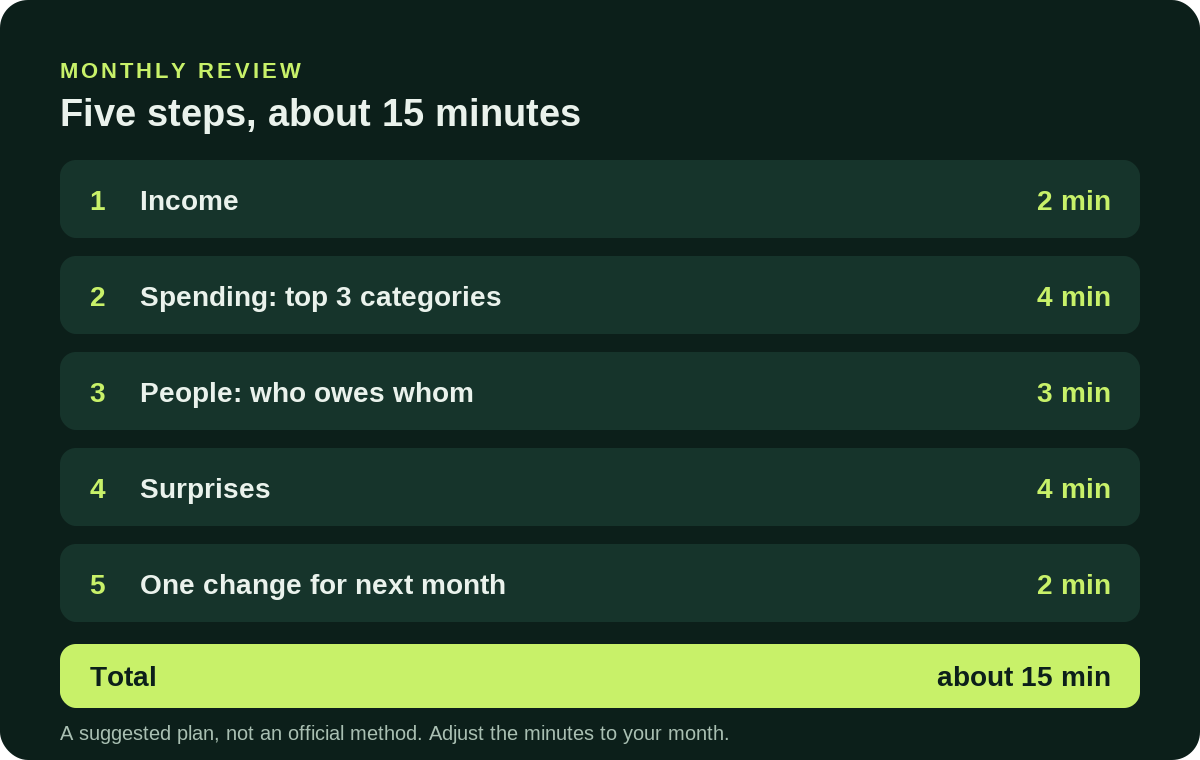
This is a suggested plan, not an official method. The minutes are a guide, so shorten or stretch them to fit your month.
| Step | Minutes | The question | Write down |
|---|---|---|---|
| 1. Income | 2 | What actually arrived this month? | Salary and any extra income, as one number each |
| 2. Spending | 4 | Which three categories took the most? | The top three, with amounts |
| 3. People | 3 | Who owes me? Whom do I owe? | Names and amounts still open |
| 4. Surprises | 4 | What did I not expect? | One or two items, such as a big bill or an unplanned gift |
| 5. One change | 2 | What will I do differently next month? | One small, specific action |
How do you review each step?
Income. Count what reached your account or hand, not what you expected. If your salary slip and your bank balance differ, our post on reading your salary slip explains the usual deductions.
Spending. Look only for the top three categories. Food, transport, bills and gifts are the common ones, but use your own. Do not try to judge every purchase. You are looking for the biggest levers.
People. This step is easy to skip and costly to skip. List every udhaar you gave and every one you owe, with the date. Money you lent is not spending, so keep it apart from your expense total. For a calm way to decide on future loans, read five questions before lending.
Surprises. Ask which item you did not see coming. A surprise bill, a family event or a "just this once" purchase. If the same surprise appears two months in a row, it is not a surprise. It belongs in next month's plan.
One change. Choose one change only. "Cook at home on weekdays" is a change. "Spend less" is not. A single small change you keep is worth more than five you drop by the 10th.
What if your records are incomplete?
Then do a short review anyway. Use your bank and wallet history for the big items and note that the rest is a guess. Mark it honestly: "about half of my cash spending is missing." The review will still show the largest categories, and it will show you why daily recording matters. Also remember that cash taken out of an ATM is a move of money, not a purchase. Our post on cash withdrawals explains how to keep it from inflating your spending.
How can Z30 help with the review?
Z30 does not write the review for you, and it does not connect to your bank. What it does today is record each line you type, such as petrol 450 cash or Ali ko 5000 udhaar diye. You can then ask "is mahine kitna kharch hua?" and see your month by category, and see who owes you and whom you owe. Lending is not counted as spending. If you made a mistake, you can undo it and your history is kept.
Every new account gets 3 months free, with no payment details needed. After that, plans are Rs 799 for 1 month, Rs 1,199 for 3 months, or Rs 10,000 for lifetime, and they do not renew automatically.
FAQ
How long should a monthly money review take?
About 15 minutes once your spending is recorded. If it takes much longer, your records are probably incomplete, which is worth fixing first.
What if I find I overspent?
Write down the top category and pick one small change for next month. A review is for learning, not for blaming yourself.
Do I need to review my spending weekly instead?
Not necessarily. A monthly review is enough to start. If you want a closer look, add a two-minute check each week, but only after the monthly habit is steady.
Should I include money I lent in my spending?
No. Lending is money you expect back, so list it under "people", not under spending. If it is not repaid, that is a separate decision.
Sources
- Zero Before 30, homepage and product description (what Z30 does today; checked November 18, 2026).
- Zero Before 30, pricing (free months and plan prices; checked November 18, 2026).
Try it with your own money: one line at a time.
Start freeRead next
- GUIDEExpense tracker in Roman Urdu: track money by typing, not filling forms
Track expenses, salary and udhaar by typing in Roman Urdu or English, the way you'd text a friend. How it works, examples, and what it does when an entry is unclear.
- How to avoid overspending in a sale: a 5-step plan
For salary earners in Pakistan: five simple steps to enjoy a sale without blowing your month, plus how to check whether a discount is real.
- Is withdrawing cash from an ATM an expense? Understanding transfers
For salary earners in Pakistan: why an ATM withdrawal is not spending, how to count cash without doubling it, and which part of a withdrawal is a real cost.
- How to keep track of money you send to family every month
For salary earners in Pakistan who support parents or siblings: how to separate regular support, one-off help and udhaar, and set a limit you can keep.