BLOG · BILLS AND HOUSEHOLD
Why is your gas bill higher in winter? Slabs, protected status and fixed charges
Short answer: in winter you burn more gas for the geyser, the heater and longer cooking, and gas is priced in slabs: the more you use in a month, the higher the slab and the higher the rate. On top of that, every bill has a fixed charge, and for non-protected homes it doubles from Rs 1,500 to Rs 3,000 once a month goes above 1.5 hm3. Your winter use also decides whether you count as a protected consumer, so this winter can affect your rates later too.
Why does the bill go up so much in winter?
Three things add up at the same time:
- More gas. Hot water, room heaters and more cooking all use gas. A few cold weeks can move you up one or two slabs.
- A higher rate per unit. Each slab has its own rate. In the non-protected category the rate climbs from Rs 500 per MMBTU in the first slab to Rs 4,200 above 4 hm3.
- A higher fixed charge. Non-protected homes pay Rs 1,500 a month up to 1.5 hm3 and Rs 3,000 above it, whatever else is on the bill.
So a winter bill is not just "more gas at the same price". The rate itself can be higher.

What do hm3 and MMBTU on the bill mean?
- hm3 (hecto cubic metre) is 100 cubic metres of gas. Your meter reading and the slabs are in hm3.
- MMBTU is a unit of heat. The gas company converts your hm3 into MMBTU, and the rate in the tariff is per MMBTU. Your bill shows both.
To compare months, look at the hm3 figure, not only the amount. The amount also moves with the fixed charge and taxes.
What are the slabs and rates right now?
The rates below come from the OGRA notification of June 29, 2025, effective July 1, 2025, as listed on SSGC's tariff page. In June 2026 the government decided to keep consumer gas prices unchanged for 2026-27, as Profit reported on July 7, 2026, so these are still the rates as of November 2026. All rates are per MMBTU, before fixed charges and taxes.
| Monthly use | Protected (Rs per MMBTU) | Not protected (Rs per MMBTU) |
|---|---|---|
| Up to 0.25 hm3 | 200 | 500 |
| Up to 0.5 hm3 | 250 | — |
| Up to 0.6 hm3 | 300 | 850 |
| Up to 0.9 hm3 | 350 | — |
| Up to 1 hm3 | — | 1,250 |
| Up to 1.5 hm3 | — | 1,450 |
| Up to 2 hm3 | — | 1,900 |
| Up to 3 hm3 | — | 3,300 |
| Up to 4 hm3 | — | 3,800 |
| Above 4 hm3 | — | 4,200 |
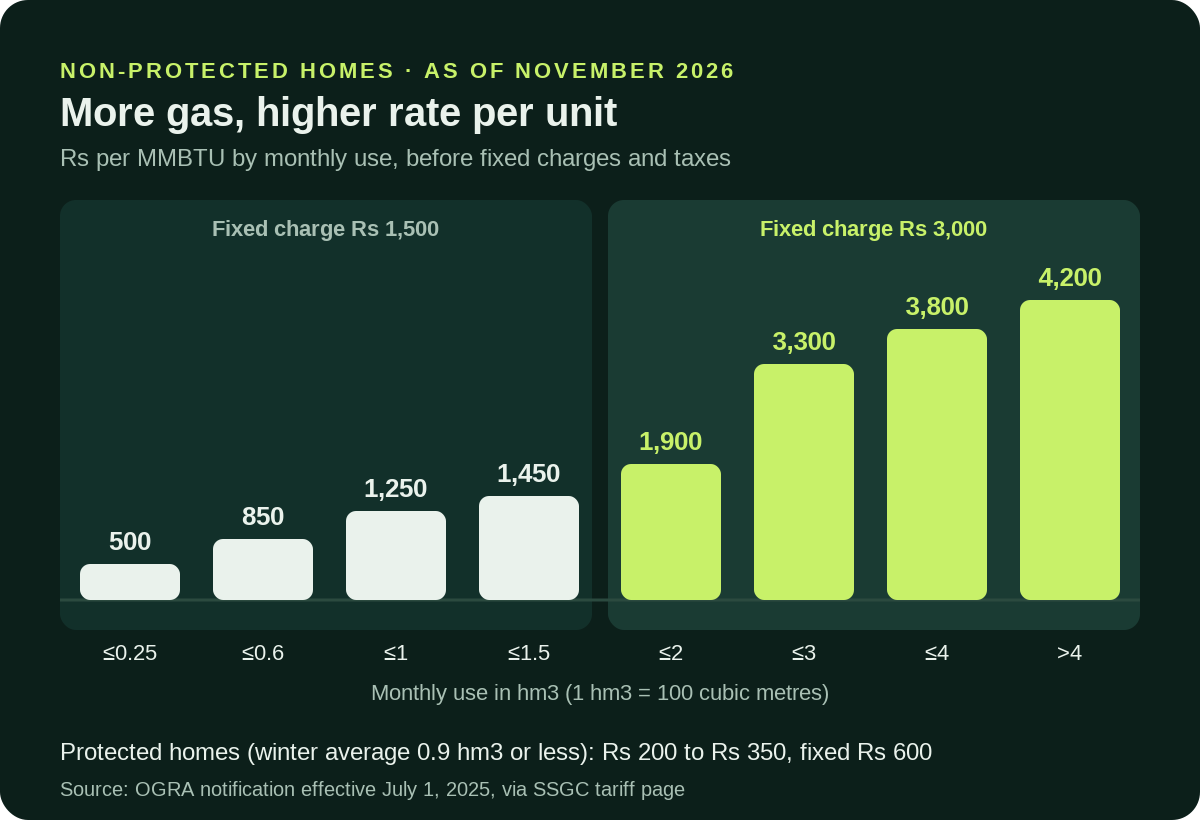
Rates can change with a new OGRA notification, so check the rate printed on your own bill.
Am I a protected or non-protected consumer?
SSGC's tariff page says a home is protected if its average gas use in the four winter months, November to February, is 0.9 hm3 or less. Every other home is non-protected.
The gap is large. In the first slab, protected homes pay Rs 200 per MMBTU and non-protected homes pay Rs 500. The fixed charge is Rs 600 for protected homes against Rs 1,500 or Rs 3,000 for non-protected homes.
Because the test looks at winter, the months you are in now matter. If your average stays at 0.9 hm3 or less from November to February, you keep (or can reach) the lower rates. If you are unsure which category you are in, check your bill or ask your gas company's helpline.
What fixed charges are on every gas bill?
| Charge | Protected | Not protected |
|---|---|---|
| Fixed charge | Rs 600 a month | Rs 1,500 (up to 1.5 hm3) or Rs 3,000 (above 1.5 hm3) |
| Meter rent | Rs 40 a month | Rs 40 a month |
| Minimum bill | At the first slab rate | At the first slab rate |
The fixed charge is there even in a month when you use very little gas.
What about load management this winter?
From November 4, 2026, SNGPL limited gas for homes in Islamabad, Punjab and Khyber Pakhtunkhwa to cooking times: 6:30 to 9:00 am, 12:00 to 2:30 pm and 6:00 to 9:00 pm, as The News reported. If you fill gaps with LPG cylinders or electric heaters, that money does not show up on your gas bill, so record it too, or your winter will look cheaper than it was.
How do you keep winter gas costs under control?
- Read your meter weekly in December and January. Note the hm3 figure. If you are close to 1.5 hm3 for the month, you know the fixed charge is about to double.
- Watch the geyser. It is often the biggest gas user in winter. Running it only when you need hot water keeps hm3 down.
- Compare with last winter. Most bills print past months. Check whether your use is above last year's.
- Pay before the due date to avoid the late payment amount.
- Record each bill and each LPG refill with your monthly spending, so you see the full cost of winter.
Z30 does not read your gas bill, track hm3 or remind you of due dates. You can record what you paid in one line, for example gas bill 3200 cash or LPG cylinder 3000 Easypaisa se, and see it in your month by category.
FAQ
Why did my bill double when I used only a little more gas?
Check two things: whether your month crossed into a higher slab, and whether it went above 1.5 hm3. For a non-protected home, crossing 1.5 hm3 raises the rate from Rs 1,450 to Rs 1,900 per MMBTU and the fixed charge from Rs 1,500 to Rs 3,000.
Are the rates different for SNGPL and SSGC?
OGRA notifies the domestic sale prices. The table above is from SSGC's published tariff page. Your bill shows the rate that applies to you; if it differs from this table, ask your gas company why.
Did gas prices go up in July 2026?
No. The government kept consumer gas prices unchanged for 2026-27, so the rates notified for July 1, 2025 still apply as of November 2026.
What if my reading looks wrong?
Take a dated photo of your meter and complain to your gas company before the due date. Keep the complaint number.
Sources
- Domestic Rates, Sui Southern Gas Company, page updated August 22, 2025 (slab rates per OGRA notification of June 29, 2025, effective July 1, 2025; fixed charges; meter rent; minimum bill; protected definition), checked November 7, 2026
- Govt keeps gas tariffs unchanged despite OGRA cut in prescribed prices, Profit, July 7, 2026 (prices unchanged for 2026-27)
- 50pc increase in fixed gas charges notified for domestic consumers, Dawn, 2025 (new fixed charges from July 1, 2025)
- SNGPL restricts gas supply to cooking hours in Islamabad, Punjab, KP, The News, November 4, 2026 (winter supply timings)
Try it with your own money: one line at a time.
Start freeRead next
- GUIDESalary kahan jaati hai? How to see where your monthly salary goes
Salary comes on the 1st and is gone by the 20th. A simple way for salary earners in Pakistan to see where it goes: write each spend in one line and let the month add itself up.
- Rent and advance: how to keep a clear record of what you paid and what you get back
Paying rent and an advance (security deposit) on a salary? What to write down so you can prove every payment and get your advance back without an argument.
- How do you cut your mobile and internet spending without losing signal?
For salary earners in Pakistan: find your real monthly mobile and internet cost, see what the FBR rate card says about tax on top-ups, and trim the waste, as of November 2026.
- How to read your electricity bill: units, slabs and taxes, line by line
For households in Pakistan: how to read units, slabs, the 200-unit protected rule, fixed charges, FPA and taxes on your electricity bill, as of November 2026.