BLOG · BILLS AND HOUSEHOLD
How do you cut your mobile and internet spending without losing signal?
Short answer: first find out what you really spend. Most people only remember the big monthly bundle and forget the small loads, the extra bundle bought when data ran out, and the home Wi-Fi bill. Add up three months, take the average, then match your package to what you actually use. One thing you cannot trim: the FBR rate card lists a 15% withholding tax on mobile and internet bills and prepaid cards, as of its June 30, 2026 update.
Why does mobile and internet spending feel higher than it is on paper?
Because it comes in pieces. A Rs 100 load here, a weekly bundle there, a "small" top-up when the balance runs out at night. None of them feels like a bill, so none of them gets written down.
The pieces usually sit in different places:
- Prepaid loads bought from a shop or sent from a wallet.
- Bundles bought from the operator's app or by a code.
- A home internet bill paid monthly.
- A second SIM that you top up "just in case".
If you only look at one of these, you will under-count the total.
How do you find your real monthly cost?
Do a three-month count. It takes about ten minutes the first time.
- List every SIM and every internet connection you pay for.
- For each one, collect last month's amounts: your wallet or bank history, the shop's loads you remember, and the home internet bill.
- Repeat for the two months before.
- Add each month's total, then divide the three totals by 3.
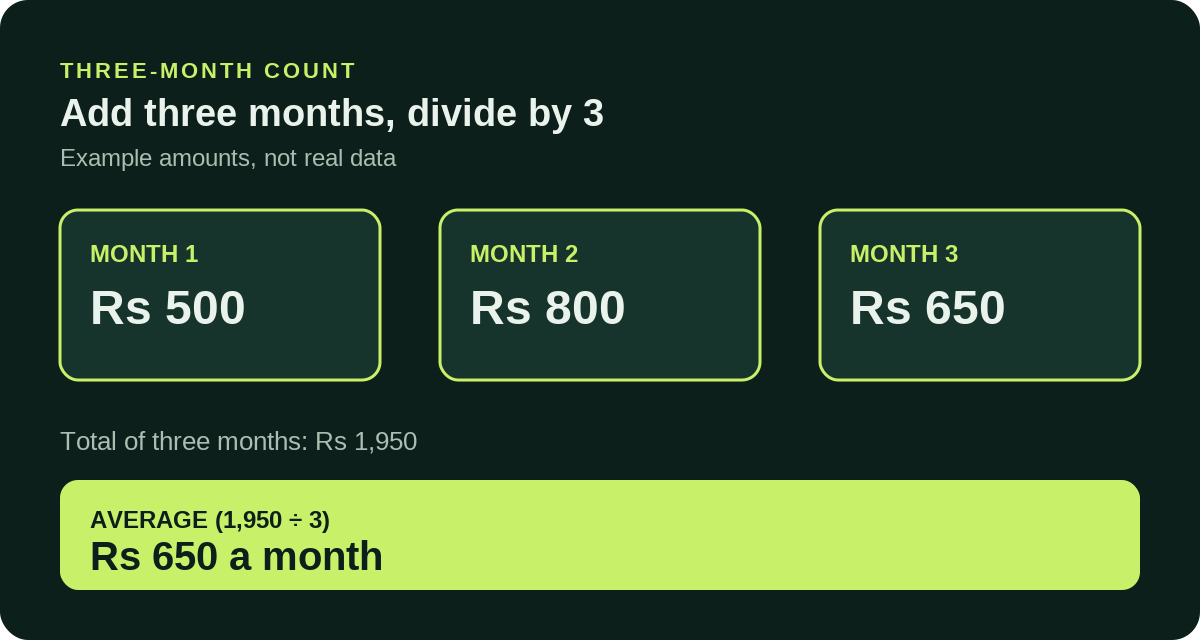
Here is an example with made-up amounts, not real data:
| Month | Loads and bundles | Home internet | Month total |
|---|---|---|---|
| Month 1 (example) | Rs 500 | Rs 0 | Rs 500 |
| Month 2 (example) | Rs 800 | Rs 0 | Rs 800 |
| Month 3 (example) | Rs 650 | Rs 0 | Rs 650 |
The three months add up to Rs 1,950, so the example average is Rs 650 a month. Your average is the number to work with, not the best month.
Which habits quietly waste money?
Look for these in your own list:
- Buying a second bundle because the first ran out early. If this happens often, the first bundle is too small for you, or something is eating data in the background.
- Paying for data you never use. If a bundle is mostly left over at the end, you are over-buying.
- Using mobile data at home when Wi-Fi is there. Phone settings can show how much data each app used. Check which apps take the most.
- A SIM you hardly use. Ask yourself if each SIM still earns its monthly load.
- Small loads at the last minute. Several small loads can cost more than one planned bundle. Compare the totals on your own list; do not assume.
Your operator's app or helpline shows the bundles available to you today. Check the details there, because bundle prices and sizes change.
Is there tax on mobile loads and internet bills?
Yes. The FBR's withholding income tax rate card, updated up to June 30, 2026 under the Finance Act 2026, has a line for section 236, "Telephone and Internet". It lists:
| Case on the FBR card | Rate on the card |
|---|---|
| Internet, mobile telephone and prepaid internet or telephone card | 15% of the amount of the bill or sales price |
| Telephone subscriber, other than mobile, where the monthly bill is above Rs 1,000 | 10% of the amount of the bill above Rs 1,000 |
So when you pay for a load or a mobile bill, tax is part of what the price covers. This is a rate card, not advice for your case: how it affects you, for example if you file a return, is a question for FBR or a tax professional. You cannot choose to skip it, so the savings are in how much you buy, not in the tax.
Does Z30 help with this?
Z30 does not connect to your operator or read your data use. It will not tell you how many GB you used. What it can do is keep your count. Type lines like these as they happen:
mobile load 500 cashinternet bill 3000 HBL se
Z30 records each as an expense, with the date and how you paid. At month end you can ask "is mahine kitna kharch hua?" and see your month by category. Your three-month average then takes a minute, not ten.
FAQ
Is a bigger bundle always cheaper per GB?
Not always, and not if you do not use it. Compare what you paid in total over three months with what you actually used. A cheaper bundle you never finish still costs more than a smaller one you do.
Should I drop my second SIM?
Ask what it is for. If it is for a job, a family number or a good signal in one place, it may be worth it. If you top it up out of habit, count what it cost you over three months and decide.
Can I avoid the tax on top-ups?
The rate card sets the tax for everyone buying these services, so the way to spend less is to buy less of what you do not use. For questions about your own tax position, ask FBR or a tax professional.
How often should I check my plan?
Once every three months is enough for most people, or when your usage changes, for example after moving house or starting a new job.
Sources
- FBR, Withholding Income Tax Rate Card, updated up to June 30, 2026 as per Finance Act, 2026: section 236, Telephone and Internet (checked November 19, 2026).
- Z30 features and pricing: zerobefore30.com.
- Related: How to track JazzCash and Easypaisa spending.
Try it with your own money: one line at a time.
Start freeRead next
- GUIDESalary kahan jaati hai? How to see where your monthly salary goes
Salary comes on the 1st and is gone by the 20th. A simple way for salary earners in Pakistan to see where it goes: write each spend in one line and let the month add itself up.
- Rent and advance: how to keep a clear record of what you paid and what you get back
Paying rent and an advance (security deposit) on a salary? What to write down so you can prove every payment and get your advance back without an argument.
- Why is your gas bill higher in winter? Slabs, protected status and fixed charges
For households on Sui gas in Pakistan: why winter bills jump, how the hm3 slabs and the protected category work, and the fixed charges, as of November 2026.
- How to read your electricity bill: units, slabs and taxes, line by line
For households in Pakistan: how to read units, slabs, the 200-unit protected rule, fixed charges, FPA and taxes on your electricity bill, as of November 2026.